> NBA Hoops Online >Hornets History >
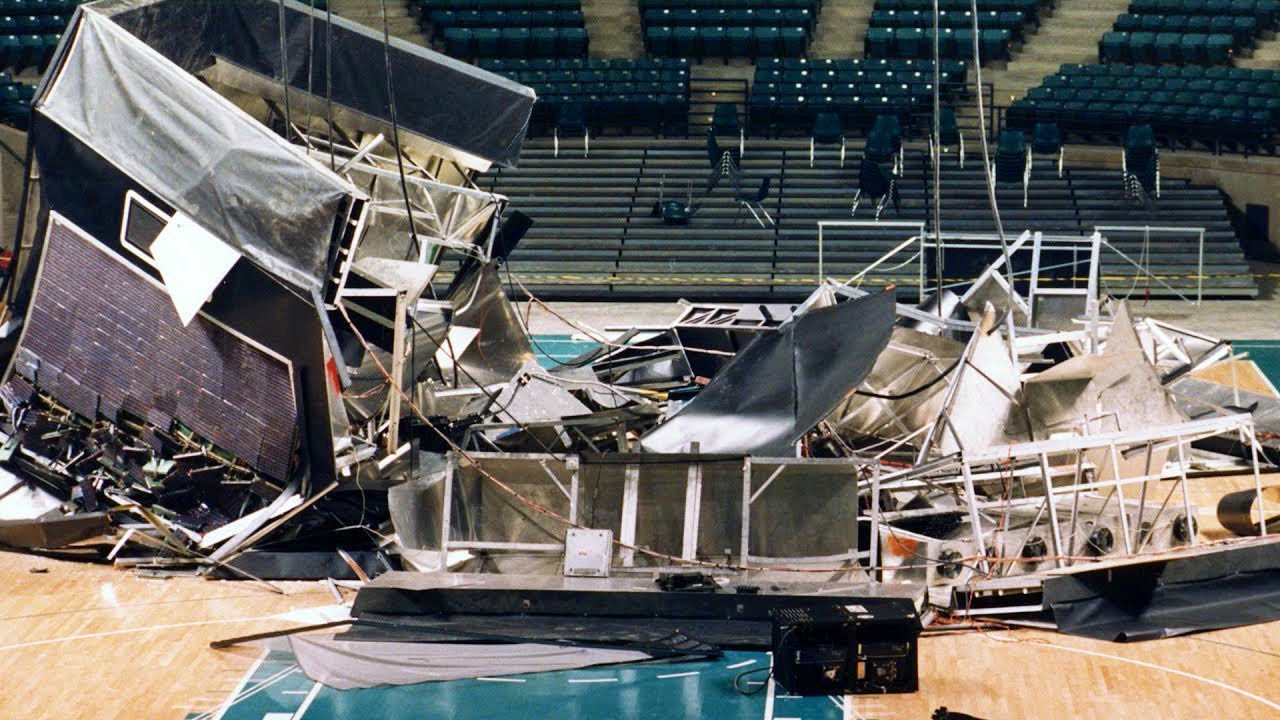
The Day the Jumbotron Fell: The Charlotte Coliseum Scoreboard Collapse of August 12, 1988
The Charlotte Hornets had not yet played a single NBA game when their brand-new home produced one of the strangest incidents in league history.
On the morning of August 12, 1988, a massive center-hung scoreboard inside the newly opened Charlotte Coliseum came crashing down onto the basketball court. The scoreboard weighed approximately 40,000 pounds, cost more than $3 million, and was supposed to be one of the technological showpieces of Charlotte's entrance into the NBA.
Instead, it became a pile of wreckage on the Coliseum floor.
Remarkably, nobody was injured.
The accident happened less than 24 hours after the $52 million arena had officially opened, giving Charlotte's new NBA era an unforgettable beginning before the expansion Hornets had even taken the court.
Charlotte's New Basketball Palace
Charlotte's arrival in the NBA was a major moment for professional sports in North Carolina.
The NBA awarded an expansion franchise to Charlotte in 1987, with the Hornets scheduled to begin play during the 1988-89 season. One of the strongest pieces of Charlotte's expansion bid was the construction of a huge new arena on Tyvola Road.
The Charlotte Coliseum was enormous by NBA standards.
With nearly 24,000 seats for basketball, it was the largest basketball-specific arena being used as a permanent NBA home. It was designed by Charlotte-based Odell Associates and cost approximately $52 million to build.
The building was intended to prove that Charlotte was ready for major-league professional sports.
Among its most impressive features was an enormous eight-sided center-hung video scoreboard. In an era when giant video boards were still relatively novel in sports arenas, the system was supposed to help make the Coliseum a state-of-the-art facility.
It almost immediately became famous for an entirely different reason.
August 11, 1988: The Coliseum Opens
The Charlotte Coliseum officially opened on August 11, 1988.
The opening included a dedication by famed evangelist and Charlotte native Billy Graham. Graham stood on the Coliseum floor beneath the enormous scoreboard during the ceremonies.
Within 24 hours, the scoreboard would be lying where Graham and others had been standing.
The timing made the accident even more remarkable.
The following day, the Coliseum was scheduled to host exhibition basketball involving the United States Olympic teams as part of preparations for the upcoming 1988 Seoul Olympics.
Workers therefore returned to the building on the morning of August 12 to prepare the arena.
That was when something went terribly wrong.
The Scoreboard Begins to Move
The massive scoreboard had been designed so that it could be raised and lowered.
According to contemporary reporting, workers had encountered problems with the system while positioning the scoreboard around the opening events. Architect Gene Bodycott told UPI that one of the two motors used to raise the structure apparently malfunctioned.
Workers were attempting to deal with the system the following morning.
At approximately 9 a.m., the scoreboard fell.
There were reportedly around 25 people inside the arena at the time. Workers realized something was wrong and began warning others to get away.
Then the enormous structure came down.
One worker told UPI that the noise made it seem as though the building itself were collapsing. Another compared the sound to the roar of a jet aircraft.
Twenty tons of electronics, metal and video equipment slammed into the brand-new basketball floor.
A $3.2 Million Pile of Wreckage
The damage was spectacular.
The scoreboard, valued at approximately $3.2 million, was destroyed. The impact also caused substantial damage to the new Coliseum floor.
Yet the most important fact was almost unbelievable:
Nobody was hurt.
Considering the scoreboard weighed around 40,000 pounds and approximately two dozen workers were reportedly in the arena, Charlotte had narrowly avoided a potentially deadly accident.
The incident became even more startling when people remembered the previous day's dedication.
Billy Graham had stood beneath the structure.
Years later, Graham occasionally joked about the fact that the scoreboard had crashed onto approximately the same area of the floor where he had stood less than a day earlier.
There Was Still a Basketball Game to Play
The collapsed scoreboard presented Charlotte officials with another immediate problem.
The new Coliseum was supposed to host basketball that night.
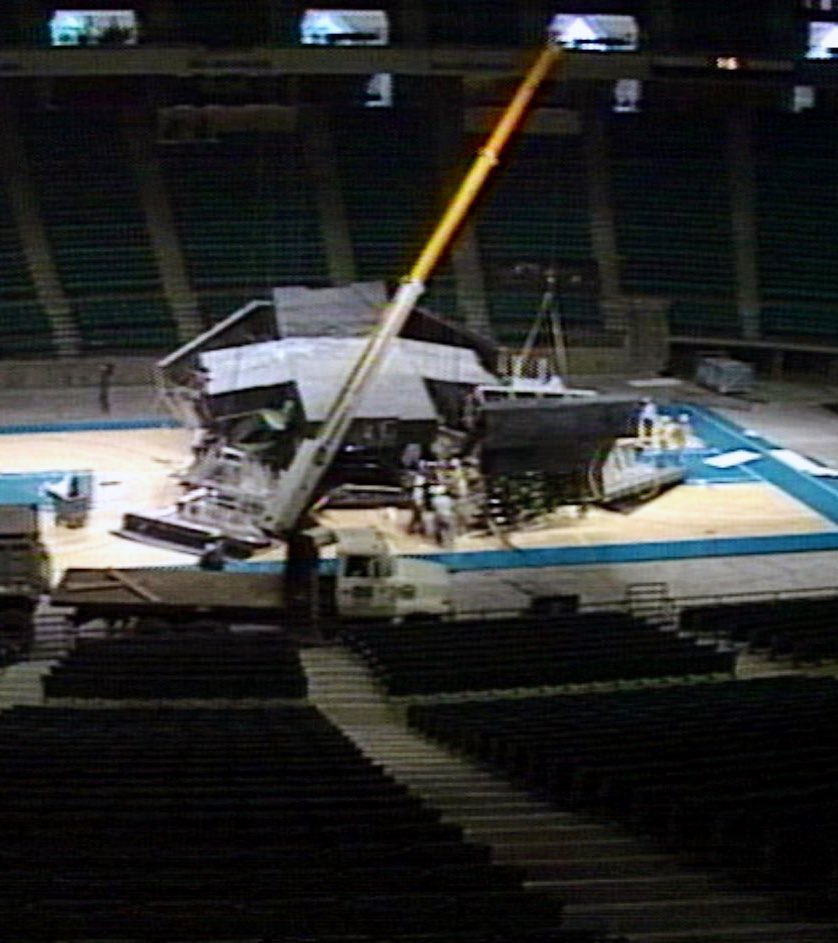
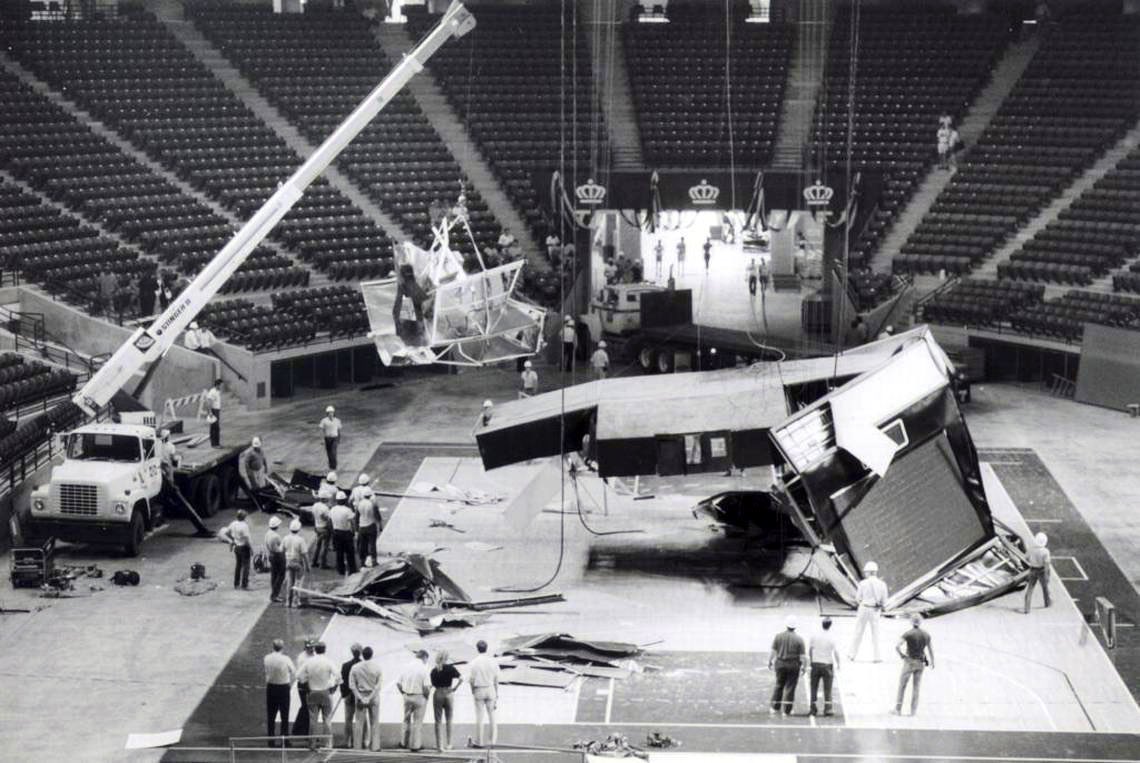
Rather than cancel the event, arena personnel launched a remarkable cleanup operation.
The destroyed scoreboard had to be removed from the playing area, while the damaged basketball floor had to be dealt with.
An alternate court was brought over from Charlotte's older Coliseum so that the scheduled basketball could proceed.
Despite the chaos that morning, the arena was made usable again.
It was an extraordinary recovery from an accident that could easily have closed the building for days or weeks.
A Bad Omen for the Hornets?
The scoreboard collapse quickly became part of the folklore surrounding Charlotte's new NBA franchise.
The Hornets had not yet played their inaugural game.
Their new $52 million arena had barely been open for a day.
And one of its most expensive technological features was already destroyed.
There were other bizarre incidents surrounding the team's arrival as well. Later in 1988, reports noted that a warehouse containing thousands of Hornets press guides had burned and recalled the scoreboard crash while discussing some of the unusual events surrounding the expansion franchise.
If the scoreboard collapse was supposed to be an omen, however, it did not apply to fan support.
Charlotte immediately fell in love with the Hornets.
The Hive Becomes One of the NBA's Loudest Arenas
The Hornets played their first regular-season home game at the Coliseum on November 4, 1988, losing 133-93 to the Cleveland Cavaliers.
The expansion team's performance on the court was initially poor, but the popularity of NBA basketball in Charlotte was extraordinary.
The Coliseum soon became known as "The Hive."
Charlotte ultimately recorded hundreds of consecutive sellouts, and the Hornets led the NBA in attendance during much of their early history. The enormous building that some critics feared would be impossible to fill became one of the league's great home-court environments.
That made the scoreboard accident even more ironic.
An arena that looked like a disaster before the Hornets played their first game soon became one of the great success stories of NBA expansion.
The Scoreboard Was Replaced
The destroyed scoreboard obviously could not remain on the floor.
A replacement was installed, and the Hornets eventually had the massive video display they had envisioned for their new home.
The center-hung scoreboard became part of the visual identity of the Coliseum.
Years later, when photographer Kent Smith Shaffner was preparing an early Hornets team photograph, owner George Shinn specifically wanted the huge scoreboard visible in the background. The board was lowered so that the players could be photographed with it above them.
The very feature that had produced one of the arena's greatest embarrassments became one of its recognizable landmarks.
An Arena That Didn't Last
The Charlotte Coliseum itself had a surprisingly short life.
Despite its enormous capacity and the Hornets' extraordinary early attendance, the building eventually became outdated because of its relative lack of luxury suites and other revenue-producing amenities.
The original Hornets moved to New Orleans after the 2001-02 season.
The NBA returned to Charlotte with the Bobcats in 2004, and the Coliseum temporarily became their home as well. A new downtown arena — today's Spectrum Center — opened in 2005.
The Charlotte Coliseum was subsequently closed.
On June 3, 2007, less than 19 years after opening, the building was demolished by implosion.
The building disappeared, but stories about "The Hive" remained an important part of Charlotte basketball history.
And few stories were stranger than what happened on its second day.
One of the Strangest Beginnings in NBA History
Most expansion franchises remember their first draft pick, first game and first victory.
Charlotte had another milestone:
the day the scoreboard fell out of the ceiling.
On August 12, 1988, approximately 40,000 pounds of state-of-the-art video equipment crashed onto the floor of an arena that had opened less than 24 hours earlier. The scoreboard was destroyed. The new court was badly damaged. Workers scrambled for safety.
Somehow, nobody was injured.
And somehow, they still played basketball in the building that night.
It was an appropriately chaotic beginning for a franchise that would soon become one of the NBA's most colorful phenomena. Within months, Charlotte was filling the enormous Coliseum with teal-and-purple-clad fans, and "The Hive" became one of the most recognizable arenas of the 1990s.
But before Muggsy Bogues, Dell Curry, Larry Johnson or Alonzo Mourning made the building famous, the Charlotte Coliseum had already created a piece of basketball history.
The arena opened on August 11, 1988.
On August 12, the Jumbotron came crashing down.
And the Charlotte Hornets' bizarre first chapter had begun.
| 