The First NBA Game: New York Knicks vs. Toronto Huskies on November 1, 1946
On November 1, 1946, the New York Knickerbockers and Toronto Huskies met at Maple Leaf Gardens in Toronto for a professional basketball game that appeared modest at the time. The crowd of 7,090 watched the Knicks escape with a 68-66 victory in a low-scoring, physical contest between two newly formed teams.
No one in attendance could have known that the game would eventually be recognized as the first contest in the history of the National Basketball Association.
The league was then called the Basketball Association of America, or BAA. It would not adopt the NBA name until 1949, when the BAA absorbed teams from the rival National Basketball League. Because the modern NBA traces its official history to the BAA, the Knicks-Huskies game is now treated as the starting point of the league's official record book.
The Creation of the Basketball Association of America
The Basketball Association of America was created on June 6, 1946, during a meeting involving owners and operators of several major hockey arenas in the United States and Canada.
Professional basketball already existed, but many teams played in smaller markets, armories, ballrooms, high school gymnasiums and other modest facilities. The National Basketball League had established teams primarily in Midwestern industrial cities, while other leagues had operated throughout the eastern United States.
The founders of the BAA believed professional basketball could become a major attraction if it were played in large arenas located in major cities.
Many of the new league's organizers controlled buildings that hosted hockey but remained empty on numerous nights during the winter. Basketball offered those arena owners another source of ticket revenue.
The new league included teams representing Boston, Chicago, Cleveland, Detroit, New York, Philadelphia, Pittsburgh, Providence, St. Louis, Toronto and Washington.
Maurice Podoloff was appointed president of the BAA. Podoloff was already serving as president of the American Hockey League, making him one of the first executives to lead two major professional sports leagues at the same time.
Why the First Game Was Played in Toronto
Toronto was selected to host the first game of the new league at Maple Leaf Gardens, one of the best-known indoor arenas in North America.
The building had opened in 1931 and was primarily associated with the National Hockey League's Toronto Maple Leafs. Its size and reputation matched the BAA's goal of bringing professional basketball into major arenas.
The Toronto Huskies were placed in the BAA's Eastern Division and represented the league's only Canadian market.
Their opening opponent was the New York Knickerbockers, a team organized by Madison Square Garden president Ned Irish. The Knicks' name was taken from the term “Knickerbockers,” which had long been connected to the Dutch heritage of New York City.
Promoting an Unfamiliar Sport
Basketball was not yet a major professional attraction in Toronto. Hockey dominated the local sports culture, and many potential spectators knew relatively little about the new league or its players.
The Huskies therefore used several promotions to attract attention to opening night.
The most famous advertisement featured Toronto center George Nostrand, who stood 6 feet 8 inches tall. The promotion promised free admission to anyone taller than Nostrand.
The advertisement asked, “Can You Top This?” and included an image of the towering Huskies player.
The offer became the first famous promotional stunt in NBA history. Few people were taller than 6 feet 8 inches in 1946, so the promotion generated publicity without costing the franchise many ticket sales.
Regular ticket prices reportedly ranged from 75 cents to $2.50.
Maple Leaf Gardens on Opening Night
A crowd of 7,090 attended the game at Maple Leaf Gardens.
The arena could accommodate a much larger crowd, but the attendance was still respectable for the debut of an unfamiliar professional basketball league.
The court was installed over the building's hockey surface, and the surroundings were considerably different from the modern NBA experience. There were no giant video screens, elaborate player introductions, digital advertisements or in-arena entertainment packages.
The game itself also looked very different from modern basketball.
There was no 24-second shot clock. Teams could hold the ball for extended periods, and offensive possessions often developed slowly. There was no three-point line, and most players relied on set shots, hook shots and close-range attempts.
Players wore short shorts, canvas shoes and relatively simple uniforms. The pace and spacing bore little resemblance to today's game.
The New York Knickerbockers
The Knicks were coached by Neil Cohalan, who had previously coached college basketball at Manhattan College.
New York's roster included several players with experience in independent basketball leagues, college programs and military teams.
Among the Knicks' most important players were Leo Gottlieb, Ossie Schectman, Stan Stutz, Ralph Kaplowitz, Jake Weber, Sonny Hertzberg and Nat Militzok.
The roster reflected the strong connection between early professional basketball and the Jewish basketball community of New York. Several members of the inaugural Knicks had developed their games in neighborhood leagues, settlement houses and other competitive basketball environments around the city.
The Toronto Huskies
Toronto was initially led by player-coach Ed Sadowski, an experienced center who had already played in the National Basketball League.
Sadowski was one of the most established professional players on either roster. At approximately 6 feet 5 inches, he combined size, strength and a dependable inside scoring game.
The Huskies also featured George Nostrand, Charlie Hoefer, Ray Wertis, Mike McCarron, Dick Fitzgerald, Bob Fitzgerald, Frank Fucarino and Hank Biasatti.
Biasatti was a Canadian athlete who also played professional baseball. He became the first Canadian-born player to appear in what is now recognized as an NBA game.
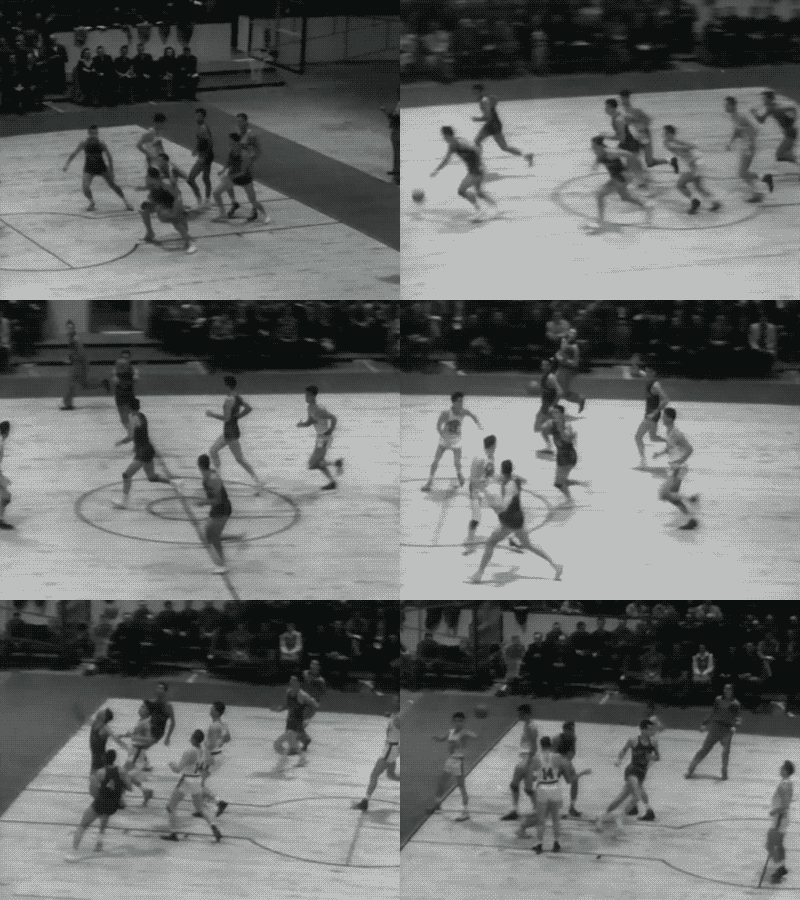
Ossie Schectman Scores the First Basket
Ossie Schectman holds one of the most important distinctions in basketball history.
Early in the game, Schectman scored on a close-range shot for New York. Because the contest was the first in BAA history, his basket is officially recognized as the first field goal in NBA history.
The moment was not celebrated with a stoppage, announcement or ceremonial presentation. It was simply another basket in the opening minutes of a newly formed professional league.
Only years later, after the BAA evolved into the NBA, did the historical importance of Schectman's score become fully recognized.
Schectman finished the game with 11 points, making four field goals and three free throws.
A Close and Competitive Game
The first game remained close throughout the evening.
Toronto relied heavily on Sadowski and Nostrand near the basket, while New York received scoring from several different players.
The Knicks did not have one overwhelming star. Instead, they used a balanced attack that included eight players scoring at least four points.
Toronto held its own inside and made one more field goal than New York, finishing with 25 compared with the Knicks' 24.
The difference came at the free-throw line.
New York made 20 of its 27 free-throw attempts. Toronto also attempted 27 free throws but converted only 16.
Those four additional made free throws provided the exact margin of victory in New York's 68-66 win.
Leo Gottlieb Leads the Knicks
Leo Gottlieb led New York with 14 points.
Gottlieb made six field goals and two free throws, finishing as the Knicks' leading scorer in the first game in franchise history.
Known by the nickname “Ace,” Gottlieb had built his reputation playing basketball in New York before joining the Knicks.
His professional career was brief, but his performance in Toronto permanently placed him in the NBA record book as the leading scorer for the winning team in the league's first game.
Ed Sadowski Leads All Scorers
Although Toronto lost, Ed Sadowski led all players with 18 points.
He made eight field goals and two free throws while serving as both a player and coach for the Huskies.
George Nostrand added 16 points, giving Toronto a combined 34 points from its two primary interior players.
The pair accounted for more than half of the Huskies' total offense.
Final Score
| Date |
Visiting Team |
Home Team |
Final Score |
Arena |
Attendance |
| November 1, 1946 |
New York Knickerbockers |
Toronto Huskies |
New York 68, Toronto 66 |
Maple Leaf Gardens |
7,090 |
New York Knickerbockers Box Score
| Player |
Field Goals |
Free Throws |
Free-Throw Attempts |
Free-Throw Percentage |
Points |
| Leo Gottlieb |
6 |
2 |
4 |
.500 |
14 |
| Ossie Schectman |
4 |
3 |
5 |
.600 |
11 |
| Stan Stutz |
2 |
5 |
5 |
1.000 |
9 |
| Ralph Kaplowitz |
3 |
1 |
1 |
1.000 |
7 |
| Jake Weber |
1 |
4 |
4 |
1.000 |
6 |
| Dick Murphy |
2 |
1 |
1 |
1.000 |
5 |
| Hank Rosenstein |
2 |
1 |
2 |
.500 |
5 |
| Nat Militzok |
2 |
1 |
1 |
1.000 |
5 |
| Tommy Byrnes |
1 |
2 |
2 |
1.000 |
4 |
| Sonny Hertzberg |
1 |
0 |
0 |
.000 |
2 |
| Bob Mullens |
0 |
0 |
1 |
.000 |
0 |
| Team Totals |
24 |
20 |
27 |
.741 |
68 |
Toronto Huskies Box Score
| Player |
Field Goals |
Free Throws |
Free-Throw Attempts |
Free-Throw Percentage |
Points |
| Ed Sadowski |
8 |
2 |
6 |
.333 |
18 |
| George Nostrand |
7 |
2 |
7 |
.286 |
16 |
| Charlie Hoefer |
2 |
4 |
4 |
1.000 |
8 |
| Mike McCarron |
1 |
4 |
5 |
.800 |
6 |
| Ray Wertis |
3 |
0 |
0 |
.000 |
6 |
| Dick Fitzgerald |
3 |
0 |
3 |
.000 |
6 |
| Bob Fitzgerald |
1 |
2 |
2 |
1.000 |
4 |
| Harry Miller |
0 |
1 |
1 |
1.000 |
1 |
| Frank Fucarino |
0 |
1 |
1 |
1.000 |
1 |
| Roy Hurley |
0 |
0 |
0 |
.000 |
0 |
| Hank Biasatti |
0 |
0 |
0 |
.000 |
0 |
| Team Totals |
25 |
16 |
29 |
.552 |
66 |
Key Statistical Differences
| Category |
New York |
Toronto |
| Field Goals Made |
24 |
25 |
| Free Throws Made |
20 |
16 |
| Points |
68 |
66 |
| Leading Scorer |
Leo Gottlieb, 14 |
Ed Sadowski, 18 |
The Knicks Begin Their History With a Victory
The victory gave New York a 1-0 record and the first win in franchise history.
The Knicks remain one of the NBA's oldest continuous franchises. They are also one of only a small number of original BAA teams that have never relocated or changed their nickname.
New York finished the 1946-47 regular season with a 33-27 record. The Knicks qualified for the playoffs and defeated the Cleveland Rebels before losing to the Philadelphia Warriors.
Philadelphia went on to win the first BAA championship.
The Huskies' Difficult Season
The narrow opening-night loss foreshadowed a difficult season for Toronto.
The Huskies struggled to attract consistent crowds and experienced numerous roster and coaching changes. Ed Sadowski was eventually traded, and the team used several coaches during the campaign.
Toronto finished the season with a 22-38 record and placed last in the Eastern Division.
The franchise folded after only one year.
The Huskies therefore played in the first NBA game but did not survive long enough to become a permanent part of the league.
Professional Basketball Eventually Returns to Toronto
Toronto remained without an NBA team for nearly five decades after the Huskies folded.
The NBA returned to Canada in 1995 with the expansion Toronto Raptors and Vancouver Grizzlies.
The Raptors deliberately incorporated elements of Toronto basketball history into their identity and have occasionally honored the Huskies with throwback uniforms.
On November 1, 1996, exactly 50 years after the first game, the Raptors hosted the Knicks at SkyDome in Toronto. New York again won, defeating Toronto 107-99.
The NBA also celebrated the 75th anniversary of the original game during the 2021-22 season.
The BAA Becomes the NBA
The Basketball Association of America operated for three seasons.
In 1949, the BAA absorbed several teams from the National Basketball League and reorganized under a new name: the National Basketball Association.
The merger brought together major-market BAA franchises and established NBL organizations such as the Minneapolis Lakers, Rochester Royals, Fort Wayne Pistons and Syracuse Nationals.
Although the NBA name did not exist in 1946, the league recognizes the BAA's games, teams and statistics as part of its official history.
That decision makes the November 1, 1946 contest in Toronto the first official game in NBA history.
How Different Was Basketball in 1946?
The sport played by the Knicks and Huskies differed substantially from the modern NBA.
There was no shot clock, so teams could protect leads by holding the ball. The 24-second clock was not introduced until the 1954-55 season.
There was no three-point line. Every successful field goal counted for two points regardless of distance.
Substitution patterns were different, statistical records were limited, travel was less comfortable and players earned far less than modern professionals.
NBAHoopsOnline notes that many early salaries were around $5,000 per season. The original BAA franchise fee was approximately $10,000.
The league offered limited national exposure, and most games were promoted locally through newspapers, posters and arena advertising.
Notable Firsts From the Game
- First game in BAA and NBA history
- First NBA victory: New York Knickerbockers
- First NBA defeat: Toronto Huskies
- First basket: Ossie Schectman
- First game's leading scorer: Ed Sadowski with 18 points
- First winning team's leading scorer: Leo Gottlieb with 14 points
- First Canadian-born NBA player: Hank Biasatti
- First famous NBA promotional stunt: free admission for anyone taller than George Nostrand
- First NBA game played outside the United States
Maple Leaf Gardens' Place in Basketball History
Maple Leaf Gardens is primarily remembered as one of hockey's most historic buildings, but it also occupies an important place in basketball history.
The arena hosted the beginning of what became one of the world's largest professional sports leagues.
The building no longer operates in its original form. Much of the structure has been converted for retail and athletic use, but the historic exterior remains in downtown Toronto.
Its role in hosting the first NBA game adds another chapter to a venue already associated with countless major sporting and entertainment events.
The Legacy of Ossie Schectman
Ossie Schectman's professional career lasted only one BAA season, but his first basket ensured his permanent place in basketball history.
Schectman later became a symbol of the NBA's earliest years. As the league grew, historians repeatedly returned to the story of the New York guard who scored the first points in a game few people realized would become historically significant.
He lived long enough to see the NBA become a global league and frequently discussed the first game in interviews and anniversary features.
The Legacy of the First NBA Game
The first NBA game was not a championship contest, a sellout or a meeting between famous superstars.
It was a two-point game between two newly created franchises playing in front of slightly more than 7,000 spectators.
One of those franchises folded after a single season. Many of the players soon left professional basketball. The league itself changed names only three years later.
Yet everything that followed—the rise of George Mikan, Bill Russell, Wilt Chamberlain, Kareem Abdul-Jabbar, Magic Johnson, Larry Bird, Michael Jordan, Kobe Bryant, LeBron James and generations of other stars—became part of the same official history that began that night.
The Knicks' 68-66 victory over the Huskies was the first entry in a record book that eventually grew to include tens of thousands of games, global television audiences, international players and franchises worth billions of dollars.
On November 1, 1946, professional basketball took a small but historic step inside Maple Leaf Gardens. The players were not yet members of something called the NBA, but they had begun its story.
Interesting Facts:
-Player salaries were around $5000 per season.
-The first BAA teams paid a $10,000 franchise fee.
-If you were taller than the tallest Huskies player (6 ft 8 in), you could attend the opening game for free.

Advertising Marquee
 
Promo ads for first ever NBA game.


Newspaper article about the game


News articles about the first ever BAA game.
| 

