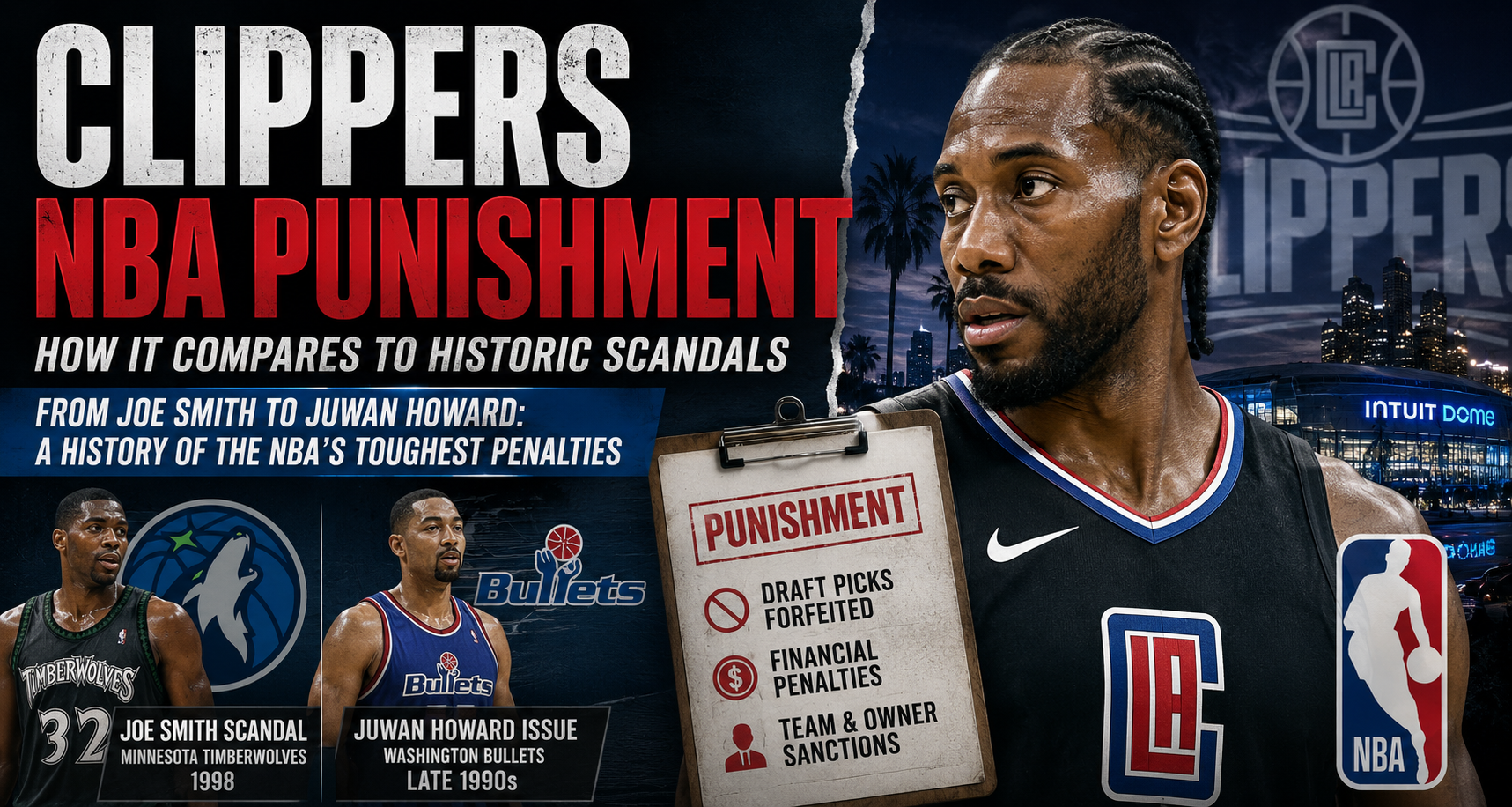
The NBA Throws the Book at the Clippers: How the Kawhi Leonard Punishment Compares to Joe Smith, Juwan Howard and the League’s Salary-Cap History
For more than four decades, the NBA salary cap has depended on something that cannot be completely written into any Collective Bargaining Agreement: trust.
Teams are allowed to exploit exceptions. They can structure contracts creatively. They can make trades designed almost entirely around cap mathematics. They can use Bird rights, mid-level exceptions, minimum contracts, sign-and-trades and increasingly complicated provisions to squeeze every possible dollar out of their available payroll.
What they cannot do is create compensation outside the system that functions as additional payment to a player.
That distinction is what makes the Los Angeles Clippers' 2026 salary-cap scandal one of the most significant punishment cases in NBA history.
On September 2, 2026, the NBA announced sweeping penalties against the Clippers after an independent investigation concluded that the organization violated the league's salary-cap circumvention rules through arrangements connected to Kawhi Leonard.
The punishment immediately invited comparison to the most notorious salary-cap scandal the league had previously seen: the Minnesota Timberwolves' secret agreement with Joe Smith in 2000.
There is another important historical comparison as well. Four years before the Smith scandal, Juwan Howard's attempted move from the Washington Bullets to the Miami Heat produced one of the strangest contract disputes in NBA history and demonstrated how aggressively the league was willing to enforce its salary-cap rules even when doing so meant invalidating a superstar contract worth more than $100 million.
The three cases are not identical.
In fact, the differences between them reveal how the NBA's approach to salary-cap enforcement has evolved from policing contracts themselves to policing the entire economic relationship between teams, players, sponsors and outside businesses.
The Clippers' 2026 Punishment
The NBA's punishment of the Clippers was enormous by league standards.
Los Angeles was ordered to forfeit its first-round draft selections in five consecutive drafts:
- 2029 first-round pick
- 2030 first-round pick
- 2031 first-round pick
- 2032 first-round pick
- 2033 first-round pick
The Clippers were also fined $30 million.
Owner Steve Ballmer was suspended from all team and league activities for one year. Clippers President of Business Operations Gillian Zucker received a one-year suspension without pay, while President of Basketball Operations Lawrence Frank was suspended without pay for six months.
Kawhi Leonard was also fined $700,000, while the organization was placed into an NBA-supervised compliance and monitoring program for five years.
The significance of the punishment goes far beyond the money. The long-term impact is also the kind of NBA
storyline that draws discussion across established sports communities
such as TheRX, particularly as fans assess how roster and front-office changes may affect future expectations.
Ballmer is one of the wealthiest owners in professional sports. A financial penalty, even one as large as $30 million, is unlikely to fundamentally alter the Clippers' ability to operate.
Draft picks are different.
First-round selections are not simply opportunities to draft players. In the modern NBA they are among the league's most valuable forms of currency. They are used to acquire stars, complete multi-team trades, move undesirable contracts and rebuild aging rosters.
By removing five consecutive first-round picks, the NBA attacked the Clippers in the area where the punishment could have the greatest basketball impact.
What the NBA Said the Clippers Did Wrong
The league's investigation focused on off-court compensation connected to Leonard.
According to the NBA's findings, the Clippers initiated or facilitated income opportunities involving Leonard and companies that were conducting business with the franchise. Those companies included Aspiration Partners, Boingo Wireless, Daktronics and Lockton Insurance.
The league concluded that Clippers personnel did more than simply introduce Leonard to potential sponsors.
The NBA determined that the organization facilitated endorsement arrangements, offered team business as an incentive for companies to enter into agreements with Leonard, paid certain personal expenses involving Leonard and his representatives, and failed to properly report solicitations for additional off-court income.
That last distinction is crucial.
NBA players are obviously allowed to have endorsement deals.
LeBron James can sign a shoe contract. Stephen Curry can appear in advertisements. Nikola Jokic can endorse a product. None of those arrangements automatically count against a team's salary cap.
The problem occurs when a team effectively uses an outside company as another method of compensating a player.
If a franchise could simply tell a superstar, "We can only pay you $50 million under the NBA contract, but one of our business partners will give you another $20 million," the salary cap would become almost meaningless.
That is why anti-circumvention rules exist.
The Clippers Had Already Been Warned
One of the most damaging elements of the 2026 case is that the Clippers were not entering unfamiliar territory.
The NBA had previously fined the franchise $250,000 in 2015 for violating anti-circumvention rules during its recruitment of DeAndre Jordan.
During a presentation to Jordan, the Clippers improperly included a possible third-party endorsement opportunity. The NBA ultimately determined that the endorsement discussion did not influence Jordan's decision to re-sign, but the league still ruled that the presentation violated its rules.
That earlier case was comparatively minor.
No draft picks were lost. No owner was suspended. The fine was a fraction of the 2026 penalty.
But historically, the 2015 case matters because it meant the Clippers had already been put on notice about exactly the kind of relationship the NBA considers dangerous: a team connecting player compensation with outside commercial opportunities.
When the NBA announced the Leonard penalties in 2026, it specifically identified the Clippers as a prior offender.
That helped transform the case from a questionable endorsement arrangement into what the league characterized as an organizational failure.
The Closest Precedent: Joe Smith and the Minnesota Timberwolves
If the Clippers punishment feels familiar, there is a reason.
The NBA has essentially reached for the Joe Smith playbook.
In October 2000, Commissioner David Stern handed the Minnesota Timberwolves what was then widely considered the harshest punishment in NBA history for salary-cap circumvention.
Minnesota had entered into a secret arrangement with forward Joe Smith designed to manipulate the league's free-agent rules.
Smith had been the first overall selection in the 1995 NBA Draft, but by 1998 his market value had fallen considerably from what might normally be expected of a former No. 1 pick.
Minnesota saw an opportunity.
The Timberwolves wanted Smith to sign a series of relatively inexpensive short-term contracts. After Smith accumulated enough seasons with Minnesota to establish the necessary rights, the franchise planned to reward him with a much larger long-term contract that could exceed the salary cap.
In other words, Smith would sacrifice money in the short term in exchange for an undisclosed promise of much greater compensation later.
The arrangement defeated the purpose of the salary cap because the real agreement between the two sides was different from the contract being submitted to the NBA.
The Secret Joe Smith Agreement
The most damaging part of Minnesota's conduct was that the promise was not merely implied.
There was documentation.
The parties had created a secret agreement outlining the future financial arrangement. Details eventually became public through litigation involving Smith's representatives.
Once the documents surfaced, Minnesota had little ability to argue that the situation was simply a misunderstanding about future intentions.
The NBA concluded that the Timberwolves, Smith and his representation had deliberately constructed an arrangement intended to circumvent the salary cap.
Stern responded with extraordinary force.
The Timberwolves' Original Punishment
Minnesota was initially ordered to forfeit five consecutive first-round draft picks:
The Timberwolves were fined $3.5 million, an enormous financial penalty by NBA standards at the time.
Smith's contracts with Minnesota were voided.
The decision also destroyed the contractual path Minnesota had been attempting to create for Smith.
Owner Glen Taylor and basketball executive Kevin McHale later stepped away from team operations as part of the fallout.
The message from Stern was unmistakable:
If teams secretly create a second set of financial rules for themselves, the league will punish the franchise in a way that can affect its competitive future for years.
Minnesota Did Eventually Get Two Picks Back
There is an important qualification when comparing the Smith punishment with the Clippers.
Minnesota was originally stripped of five first-round selections, but it did not ultimately lose all five.
The NBA later restored the Timberwolves' 2003 selection after Taylor and McHale cooperated with their suspensions and the league proceedings.
The league subsequently restored Minnesota's 2005 first-round pick as well.
That meant the Timberwolves ultimately forfeited first-round selections in 2001, 2002 and 2004.
Whether the Clippers could eventually receive similar relief will become an important question over the next several years.
The original Minnesota punishment establishes that forfeited draft selections are not necessarily gone forever if the commissioner later determines that cooperation, good behavior or other circumstances justify restoring them.
But Los Angeles cannot operate under the assumption that such relief will occur.
Why Losing Draft Picks Hurt Minnesota So Much
The Smith scandal could not have come at a worse time for the Timberwolves.
Minnesota had Kevin Garnett entering the prime of his career.
The franchise needed inexpensive young players and trade assets to build a championship roster around him.
Instead, Minnesota spent several seasons operating without normal access to the first round of the draft.
The effect is difficult to quantify because no one can know which players Minnesota would have selected or which trades might have been made using those picks.
But that uncertainty is exactly what makes draft-pick forfeiture such an effective punishment.
The penalty removes possibilities.
It eliminates young talent before a team can draft it and eliminates trade assets before executives can use them.
Minnesota eventually recovered well enough to reach the 2004 Western Conference Finals, but the Smith punishment remained part of the story surrounding the organization's difficulty sustaining a contender around Garnett.
The Clippers Punishment Is Essentially the Modern Joe Smith Penalty
Placed side by side, the similarities are remarkable.
| Penalty |
2026 Los Angeles Clippers |
2000 Minnesota Timberwolves |
| Primary Player |
Kawhi Leonard |
Joe Smith |
| Issue |
Improper off-court compensation and endorsement arrangements |
Secret future contract agreement |
| Initial First-Round Picks Lost |
5 |
5 |
| Team Fine |
$30 million |
$3.5 million |
| Owner Discipline |
Steve Ballmer suspended one year |
Glen Taylor removed from team activities for a period |
| Basketball Executive Discipline |
Lawrence Frank suspended six months |
Kevin McHale required to take leave |
| Player Contract Voided |
No |
Yes |
| Additional Monitoring |
Five-year NBA compliance program |
No comparable modern monitoring program |
The resemblance is too strong to ignore.
Five first-round picks in 2000.
Five first-round picks in 2026.
An owner removed from team activities.
Senior basketball executives disciplined.
A massive organizational fine.
The league appears to have treated the Smith case as the historical baseline for what deliberate salary-cap circumvention deserves.
Why Wasn't Kawhi Leonard's Contract Voided?
This is where the two scandals diverge.
Joe Smith's actual contractual arrangement with Minnesota was at the center of the circumvention scheme. The short-term contracts were part of a larger undisclosed agreement promising future compensation.
Voiding those contracts attacked the mechanism of the violation itself.
Leonard's case is structurally different.
The disputed compensation involved outside business and endorsement arrangements rather than a secret NBA player contract promising a future salary.
That distinction helps explain why the league could punish Leonard, Ballmer and the Clippers without necessarily eliminating Leonard's standard NBA contract.
From a historical perspective, that is an important development.
The NBA no longer has to find a hidden player contract to establish circumvention.
A sufficiently direct connection between a team, its commercial partners and additional player compensation can create essentially the same competitive problem.
The Juwan Howard Case: A Different Kind of Salary-Cap Crisis
The 1996 Juwan Howard case is often remembered alongside major NBA cap scandals, but it requires an important clarification.
This was not primarily a Washington Bullets circumvention scandal.
Washington ended up benefiting from the NBA's intervention.
The controversy centered on the Miami Heat.
Howard had emerged as an All-Star with the Bullets and became one of the most desirable free agents of the 1996 offseason.
Miami made the spectacular move of agreeing to a seven-year contract worth approximately $100.8 million.
For a brief period, Howard appeared to be headed to the Heat.
Then the NBA rejected the contract.
Why the NBA Rejected Howard's Miami Contract
The problem was not that Howard was prohibited from earning $100 million.
The problem was whether Miami actually possessed enough salary-cap room to give it to him.
The league determined that the Heat had exceeded the salary cap when it agreed to pay Howard approximately $9 million during the first season of the deal.
The dispute involved how Miami had accounted for other contractual obligations, including bonuses in contracts for P.J. Brown and Tim Hardaway and the status of the Heat's arrangement with Alonzo Mourning.
The league's position was that Miami's available cap space was smaller than the Heat believed.
That made Howard's contract impermissible.
The NBA therefore rejected the agreement and Howard again became available to sign.
Washington Suddenly Had Its Superstar Back
The Bullets moved quickly.
Once the NBA cleared the way, Washington signed Howard to another massive contract of its own.
For a short period, the situation became almost absurd.
Miami believed it had a valid agreement with Howard. Washington had signed him to another agreement. Lawyers, the league and the Players Association became involved, and the dispute moved toward arbitration and litigation.
Eventually the matter was settled.
Howard remained with Washington.
Miami dropped its claim to him, and the NBA dropped its circumvention charge concerning the Heat's handling of the related transactions.
The episode remains one of the strangest free-agent sagas in league history.
Why Howard Still Matters to the Clippers Case
At first glance, Howard's 1996 contract dispute seems very different from the Clippers' Leonard scandal.
It was.
But the underlying principle was the same:
The salary cap only works if the NBA is willing to reject transactions that do not comply with its rules, regardless of how important the player or franchise may be.
Howard had agreed to one of the largest contracts in league history.
Miami believed it had landed a franchise cornerstone.
None of that prevented the NBA from saying the contract could not stand.
The league was willing to introduce enormous uncertainty into a major free-agent transaction rather than accept cap calculations it believed violated the CBA.
That philosophy became even more obvious four years later when Stern punished Minnesota.
And it remains visible in the Clippers decision three decades later.
Three Cases, Three Different Types of Salary-Cap Enforcement
| Case |
Year |
Core Issue |
NBA Response |
| Juwan Howard / Miami Heat |
1996 |
Whether Miami had sufficient cap space for Howard's contract |
Howard contract rejected; legal and arbitration dispute followed |
| Joe Smith / Minnesota Timberwolves |
2000 |
Secret agreement promising future compensation |
Contracts voided, five first-round picks initially forfeited, $3.5 million fine and executive discipline |
| Kawhi Leonard / Los Angeles Clippers |
2026 |
Improper off-court income and endorsement arrangements linked to team business |
Five first-round picks forfeited, $30 million fine, owner and executive suspensions, player fine and five years of monitoring |
The Evolution of NBA Circumvention
The historical progression is fascinating.
In the Howard case, the question was largely mathematical.
Did Miami have the cap room?
In the Smith case, the question involved a hidden contractual promise.
Was Minnesota secretly promising compensation that was not reflected in the contracts submitted to the league?
In the Leonard case, the question expanded beyond the player contract itself.
Were outside commercial arrangements effectively being used to provide additional benefits connected to Leonard's relationship with the Clippers?
That evolution reflects how much more complicated NBA business has become.
Modern franchises have enormous networks of sponsors, arena partners, technology providers, investors and corporate relationships.
Players simultaneously operate their own businesses, production companies, endorsement portfolios and investment operations.
The financial worlds surrounding a superstar and the team employing him overlap far more frequently than they did in 1996 or 2000.
That makes policing circumvention significantly harder.
Why the NBA Has to Be Aggressive
The NBA's salary cap does more than control spending.
It is supposed to create a common economic framework for all 30 teams.
A wealthy owner cannot simply pay a superstar an additional $20 million outside his contract.
A team cannot promise a player a future contract that does not appear on its current books.
A franchise cannot secretly compensate a player through businesses connected to the organization.
If those practices became acceptable, the salary cap would exist mostly on paper.
The richest franchises and owners would gain an enormous recruiting advantage because the actual compensation available to players would no longer be limited by the CBA.
That is why circumvention is treated differently from an ordinary technical violation.
It threatens the system itself.
Why Draft Picks Are the NBA's Ultimate Organizational Punishment
The Smith and Leonard cases demonstrate the NBA's preferred weapon when it believes a franchise has intentionally challenged the integrity of the cap.
Take away draft picks.
A fine punishes ownership.
A suspension punishes an executive.
Draft-pick forfeiture punishes the organization.
It also creates consequences that can last long after the people involved in the original violation have left.
The Clippers' final forfeited pick is currently scheduled to come in 2033.
That is an extraordinary timeline.
Players who are children today could theoretically be entering that draft.
The Clippers roster could look completely different. The coaching staff could be different. The front office could be different.
Yet the consequences of decisions made during the Leonard era would still remain.
That is exactly what makes the punishment powerful.
The $30 Million Fine Sounds Enormous, But the Picks Matter More
The Clippers' $30 million fine dwarfs Minnesota's $3.5 million penalty in raw dollars.
But the economic environment of the league has changed dramatically since 2000.
NBA franchise values, television revenue, player salaries and overall league revenue have all exploded.
For an ownership group led by Steve Ballmer, even a record-setting fine is ultimately a finite financial expense.
Five first-round picks cannot simply be purchased back from the league.
They affect roster construction, trade flexibility and long-term planning.
That is why the draft penalty remains the real centerpiece of the NBA's decision.
Ballmer's Suspension Sends Another Message
The suspension of Steve Ballmer may be just as historically significant.
Owners occupy a unique position in professional sports.
Players can be suspended. Coaches can be fired. General managers can be replaced.
An owner owns the franchise.
Removing an owner from league and team activities, even temporarily, therefore represents one of the commissioner's strongest available statements of institutional responsibility.
The NBA's findings did not treat the Leonard situation as the misconduct of one rogue employee.
The punishment reached from the player and his representatives through basketball operations, business operations and ownership.
That is one reason the case carries such historical weight.
The Clippers Could Feel This Long After Kawhi Is Gone
The greatest irony of organizational punishment is that the consequences often outlive the competitive advantage the team was originally trying to obtain.
Minnesota's punishment affected its ability to build around Kevin Garnett years after the original Smith agreements were signed.
The same possibility now exists for Los Angeles.
The Clippers made their enormous commitment to the Leonard era because they believed acquiring a championship-level superstar could transform the franchise.
Now the organization faces the possibility that the final consequences of that era will remain on its books long after Leonard's playing relationship with Los Angeles ends.
If the Clippers struggle in the early 2030s, every missing first-round selection will bring the 2026 ruling back into the conversation.
Was the Clippers Punishment Too Harsh?
History suggests the opposite.
Once the NBA determined that deliberate circumvention had occurred, a severe punishment was almost inevitable.
The Joe Smith precedent gave the league a clear historical standard.
Minnesota lost five first-round picks initially for secretly attempting to manipulate future player compensation.
If the NBA concluded that Los Angeles had used outside business relationships to obtain a similar economic advantage, imposing a dramatically lighter punishment would have raised an obvious question:
Why was Minnesota's conduct worthy of five picks while a modern system of outside compensation was not?
The Clippers' prior 2015 violation made leniency even harder to justify.
The Most Important Difference From Joe Smith
There is nevertheless one enormous difference between the two cases.
The Smith scandal was almost beautifully simple.
There was an official contract.
There was another secret understanding.
The purpose of that understanding was to create a path toward future compensation that Minnesota could not otherwise provide.
The Leonard case represents something more complicated and potentially more important for the modern NBA.
It involves the boundary between legitimate endorsements and impermissible player compensation.
That boundary will only become more important as NBA teams and players become increasingly connected to the same corporations, investors and business partners.
The 2026 decision therefore may become a precedent that reaches far beyond the Clippers.
A Warning to the Rest of the NBA
Every NBA front office will study this case.
So will agents.
So will team sponsors.
The lesson is not that players cannot earn money away from basketball.
They obviously can.
The lesson is that teams must maintain genuine separation between NBA compensation and outside commercial opportunities.
When a team's business relationship becomes the reason a sponsor is paying a player, the arrangement enters dangerous territory.
When the franchise facilitates the payment, the danger grows.
And when the payment begins to resemble additional compensation for playing basketball, history suggests the NBA will respond aggressively.
From Howard to Smith to Leonard
Taken together, the Juwan Howard, Joe Smith and Kawhi Leonard cases tell the story of the NBA salary cap itself.
Howard demonstrated that a blockbuster contract could be rejected when the numbers did not comply with the cap.
Smith demonstrated that a secret promise could be treated as seriously as an improper contract appearing on the league's books.
Leonard demonstrates that the same principle can extend beyond traditional contracts and into the network of commercial relationships surrounding a modern superstar.
The mechanisms changed.
The NBA's underlying position did not.
A player can be paid enormous amounts of money. A team can spend every dollar the rules allow. But compensation cannot be hidden outside the system simply because the parties find a more creative way to deliver it.
Conclusion: One of the Most Important Cap Cases in NBA History
The Clippers' 2026 punishment belongs beside the Joe Smith scandal among the most significant salary-cap enforcement actions in NBA history.
In some ways, the comparison is almost exact. Both franchises were initially stripped of five consecutive first-round selections. Both ownership groups faced severe discipline. Both cases involved the league concluding that the compensation publicly represented to the NBA did not tell the complete economic story.
But the Leonard case may ultimately have broader implications.
The Joe Smith scandal told teams they could not hide future salary promises.
The Clippers case tells them they cannot accomplish the same objective through sponsors, endorsements or business relationships.
Meanwhile, the Juwan Howard saga remains an important earlier chapter—not because Washington was punished, but because the NBA demonstrated that it was willing to invalidate one of the largest contracts in basketball history rather than approve a transaction it believed violated the salary-cap system.
Thirty years of precedent lead to the same conclusion.
The NBA gives its franchises enormous freedom to manipulate the salary cap within the rules.
Cross the line into circumvention, however, and the league has repeatedly shown that it is willing to attack the thing teams value most: their ability to build for the future.
Minnesota learned that lesson in 2000.
Miami received an earlier warning through the Juwan Howard dispute in 1996.
And in 2026, the Clippers received the modern version of David Stern's old message.
The salary cap can be manipulated. It cannot be ignored.
| 