Early Stars of Basketball
We all know about players like
George Mikan,
Bob Cousy, Bob Pettit, and Bill Russell, but who were the stars of
basketball before these guys? Not many people know the answer to this
question; few, if any, have heard of Bobby McDermott, LeRoy Edwards,
Mel Riebe, Gene Englund, or Ed Sadowski. But in a bygone era of
basketball history, these guys were the best of the best. They were
the true pioneers of professional basketball.
Gene Englund
Englund was a six-foot-five forward who played his college basketball
at the University of Wisconsin. Englund was never really a superstar,
but he was an above-average player who would finish third all-time in
scoring in the
National Basketball League (NBL).
Englund would play one season in the
NBA, appearing in 46 games during the
league's inaugural season for both the
Boston Celtics
and
Tri-Cities Blackhawks.
By the time the NBA formed, however, Englund's career was nearly over.
LeRoy Edwards
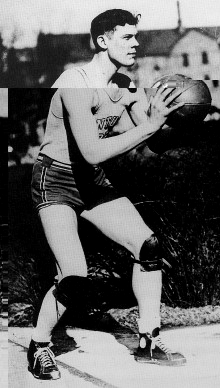
Edwards was one of the first college basketball stars. The six-foot-four
center played only two seasons for the Kentucky Wildcats but helped guide
them to an
NCAA championship
in 1933. He would leave Kentucky after his sophomore season to join the
Oshkosh All-Stars
of the National Basketball League. While with Oshkosh, Edwards would lead
the league in scoring from 1938 through 1940. He would also win
league MVP
during those years.
Edwards is the second all-time leading scorer in NBL history, behind
only Bobby McDermott, with 3,221 career points. Edwards had a relatively
short career, even by 1930s standards. He played only from 1936 through
1942, but despite that, he left an indelible mark on the game of
basketball. Edwards would be inducted into the Basketball Hall of Fame
in 1970, a year before he died.
Bobby McDermott

Of all the guys listed, McDermott was the most like a modern player.
McDermott was a shooter—the first great shooter in professional
basketball. Though, by some accounts, he was only about a 30 percent
shooter, this was vastly better than other outside shooters of his day,
who were lucky if they made 10 percent of their shots. During
McDermott's time, basketball was primarily an inside game, where big
men roamed the paint and guards were not generally scorers.
McDermott would change all of that. Not only was he a good shooter,
but he was also one of the few guards able to slash to the hoop for
layups among the giants in the paint. Ironically, for a shooter,
McDermott had very poor shooting form. He would shoot from his chest,
which made his shot easier to block, but he was accurate enough that
coaches let it go.
McDermott was also one of the first true high-school-to-pro players
in the game's history. He quit school after one year and joined the
Brooklyn Visitations of the American Basketball League.
McDermott would continue to play for the Visitations and helped lead
them to the ABL championship in 1935. He would join the New York
Professional League for one season before joining the Original Celtics.
McDermott continued to bounce around from league to league and team to
team until 1941, when he joined the
Fort Wayne Zollner Pistons
of the National Basketball League.
McDermott's peak came with the Pistons and the NBL, as he would go on
to become the league's all-time leading scorer and help lead Fort Wayne
to two NBL titles. By 1947, McDermott's playing days were drawing to a
close. He decided to join the
Chicago American Gears
as a player-coach despite receiving a nice offer from the newly formed
Basketball Association of America (BAA).
During the 1946-47 season, McDermott was paired with a young, rising
center named
George Mikan.
The Gears would go on to win the
NBL championship.
The next season, Mikan tried to convince McDermott to make the jump
with him to the
Minneapolis Lakers,
but McDermott declined and continued to play in smaller leagues.
When the NBL and BAA merged in 1949 to form the National Basketball
Association, McDermott did not follow suit.
He would eventually retire from basketball, and very little is known
about what happened following his playing career. McDermott died in
1963 and was elected to the Basketball Hall of Fame in 1988.
Mel Riebe
Riebe, a 5-foot-11 guard from the College of Wooster, is widely
considered to be the greatest player in the histories of both the
Cleveland Chase Brassmen
and
Cleveland Allmen Transfers.
Riebe played for the Cleveland teams from 1943 until they folded in
1947. He would then go on to join the
Boston Celtics.
With the Allmen Transfers, Riebe would lead the
NBL in scoring
in 1944 and 1945. He would also become the first player in league
history to average more than 20 points per game, which he accomplished
in 1945 when he averaged 20.2 points per game.
Riebe was a scoring machine in his early days, but he lacked some of
the other fundamentals that set players such as McDermott and Edwards
apart. That is likely one reason he is less remembered than the other
two.
When Riebe later joined the
Cleveland Rebels,
aging and the increased level of talent began to slow him down. After
the 1946-47 season, Riebe left Cleveland and joined the Boston Celtics.
He would play a season and a half with the Celtics before finishing
his career with the
Providence Steamrollers.
Riebe died in 1977 without having been inducted into the Basketball
Hall of Fame. He remains one of the notable early professional
basketball stars who has not been enshrined in Springfield.
Ed Sadowski
Sadowski, a Seton Hall product, joined the ranks of professional
basketball in 1940 with the
Indianapolis Kautskys.
He then played with the Rebels alongside Mel Riebe. The pair made a
formidable duo but were unable to lead the team to significant success.
In 1946, he joined the
Toronto Huskies.
He appeared in only 10 games because he also served as the team's
first head coach. After being released by the Huskies, Sadowski once
again returned to the Rebels.
Sadowski would later join the BAA's Boston Celtics, where he played
one season, averaged just under 20 points per game, and became the
first Boston Celtics player to earn All-BAA/NBA honors.
He would go on to play for the
Philadelphia Warriors
for two seasons and later for the original
Baltimore Bullets.
