 1967-70  1970-76 |
|
Player info All-time Roster Numerical Roster Team Photos Penny Anne Early | Team info Kentucky Colonels Standings | Stats Roster and Stats Head-to-Head |
Quick facts:

Founded:   1967
Folded:    1976
Arena:     1967-70: Convention Center (5,900)
           1970-76: Freedom Hall (16,613)
           1975-76: Cincinnati	Riverfront Coliseum - 14 games only (16,850)
Titles:    1 (1975)
Playoffs:
Longevity:The Colonels, along with the Indiana Pacers, were one of the only teams to play all 9 seasons of the ABA and along with the Pacers the only one not to relocate during their tenure. One reason for this success was due to their success on the court, they made the playoffs all nine seasons and made the ABA finals four times. The team would field good and competitive teams which kept fans coming to the game and gate receipts high.
The Colonels would finish with the most wins of any ABA team, but only one title.
Publicity Stunts:
Like most ABA teams, and many NBA teams, of the time the Colonels had many publicity stunts to try and attract fans to the games. The most famous of these might be the Penny Anne Early game, where a woman was allowed to enter the game, dribble the ball, and exit the game, marking the only time a woman has played in an NBA or ABA game. Other stunts involved meeting famous celebrities like Muhammud Ali, or a Richard Nixon look-a-like contest.
The Colonels also had a live dog as a mascot. The dogs name was Ziggy and was a Brussels Griffon. Ziggy was owned by original team owners Joe and Mamie Gregory - daughter of former U.S. Senator Robert R. Reynolds
John Y. Brown
John Y. Brown, one of the most successful businessmen in American history, who is credited with building KFC into the franchise it is today, owed the Colonels for most of their history and would fight with the NBA to keep the Colonels alive. When the leagues merged Brown wanted the Colonels to join the NBA, but the NBA did not want a team in Kentucky, so instead Brown was offered $3 million dollars; which he accepted.
Brown used the money from the sale of the Colonels to buy the NBA's Buffalo Braves. Shortly thereafter, Brown and Celtics owner Irv Levin "traded franchises" with Brown taking over the Celtics and Levin taking over the Braves. The move allowed Levin to move the Braves to San Diego and rename them the Clippers.
Brown would soon sour his relations with Celtics president and legend Red Auerbach and with the Boston community for several trades he made without consulting Auerbach. Eventually, Brown sold out his interest in the Celtics.
Equal Opportunity:
The Colonels embraced the sexual revolution of the late 1960s and 1970s like no business in America. The Colonels had, thus far, the only woman to play professional basketball in a men's league when Penny Anne Early played one second for them in a publicity stunt. More importantly, they had a board made up of 10 women who oversaw the franchise. The board was lead by owner John Y. Brown's wife. This marks the only time that an executive board of any professional sports team was made up entirely of women.
Competition with the NBA:
Due to John Y. Brown's desire to own an NBA team, he often tried to set up games vs NBA teams in order to prove his teams could compete. He once famously offered the NBA champion Golden State Warriors one million dollars to play the ABA Champion Colonels in a true World Championship, but the Warriors refused.
Just because the Warriors refused did not mean that Brown did not have success in playing against the NBA. The Colonels played against more NBA teams than any ABA team, and once blow out the Eastern Champion Baltimore Bullets in a game. The Colonels also would play double headers against two different NBA opponents.
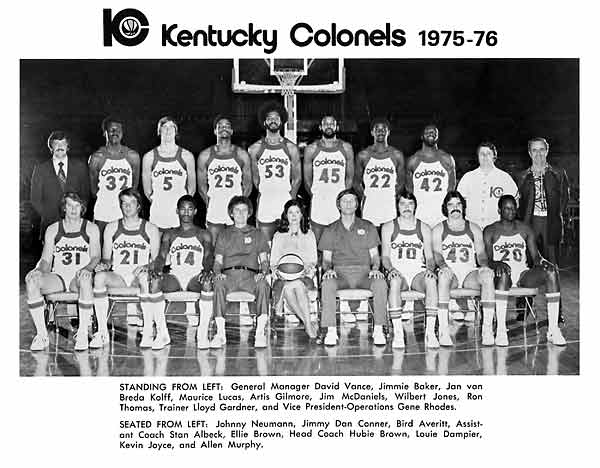

Artis Gilmore hands the ball off to Dan Issell circa 1975.

The ABA was known for its antics and promotions, this though has got to be one of the cooler ones any team every did.
|
The Baltimore Claws were one of the shortest-lived franchises in professional basketball history. The team existed during the turbulent final months of the American Basketball Association and played only three preseason exhibition games before being expelled from the league in October 1975. The collapse of the Claws was not an isolated event. It was an early warning of the financial disaster that overwhelmed the ABA during its final season. Within weeks, the San Diego Sails and Utah Stars also ceased operations. The Virginia Squires barely completed the regular season before folding, leaving only six teams to finish the ABA's final campaign. By the summer of 1976, the struggling league could no longer survive independently. Four ABA franchises joined the NBA, two others folded during the merger negotiations, and the original ABA disappeared after nine seasons
|
| Tweet |